
Arriaga began his musical education under the guidance of his father and older brother before becoming an organist at just seventeen.
Arriaga's life was tragically short; he passed away at the age of 19 on January 17, 1826.
Juan Crisóstomo de Arriaga is often referred to as the "Spanish Mozart" due to his remarkable talent and early death.
Biography
Early Life
Juan Crisóstomo Jacobo Antonio de Arriaga y Balzola was born in Bilbao, Biscay, on January 27, 1806, coinciding with what would have been Wolfgang Amadeus Mozart's fiftieth birthday. His musical journey began at home, where his father, Juan Simón de Arriaga, and older brother introduced him to music. By the age of seventeen, Arriaga was already serving as an organist at a church in Berriatúa. His father's successful career as a merchant allowed him to support Juan Crisóstomo's burgeoning musical talents.
Education and Career
In September 1821, Arriaga moved to Paris to further his studies, where he was mentored by notable figures such as Pierre Baillot for violin, Luigi Cherubini for counterpoint, and François-Joseph Fétis for harmony at the Paris Conservatoire. His exceptional talent quickly garnered attention; Cherubini famously praised Arriaga's Stabat Mater, exclaiming, "Amazing – you are music itself." By 1823, he had become a teaching assistant in Fétis's class, earning admiration from both peers and faculty.
Legacy
Despite his promising career, Arriaga's life was tragically cut short when he died at the young age of 19 on January 17, 1826. Posthumously, he earned the nickname "the Spanish Mozart" due to his prodigious talent and early death, mirroring the life of his illustrious predecessor. His works, particularly in classical music, continue to be celebrated, with several albums featuring his compositions, including string quartets and symphonies, ensuring his legacy endures in the world of music.
Collected from open sources (4) · facts link to sources · AI-processed
Discography
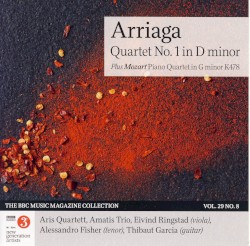 BBC Music, Volume 29, Number 8: Arriaga: String Quartet No. 1 / Giuliani: Six Cavatine / Mozart: Piano Quartet in G min K4782021
Tracklist not collected yet.
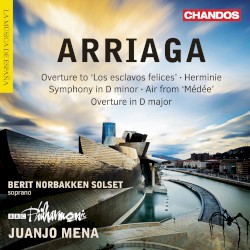 Overture to “Los esclavos felices” / Herminie / Symphony in D minor / Air from “Médée” / Overture in D major2019
Tracklist not collected yet.
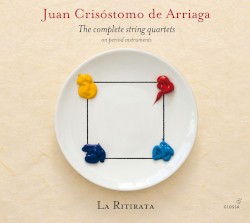 The Complete String Quartets on Period Instruments2014
Tracklist not collected yet.
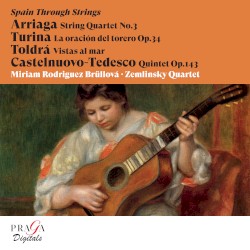 Spain Through Strings2013
Tracklist not collected yet.
 Intuition2012
Tracklist not collected yet.
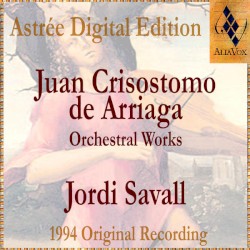 L'Œuvre Orchestrale2009
Tracklist not collected yet.
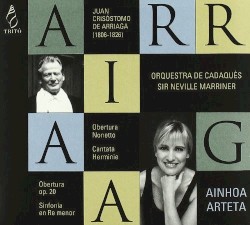 Obertura Nonetto / Cantata Herminie / Obertura, op. 20 / Sinfonía en re menor2007
Tracklist not collected yet.
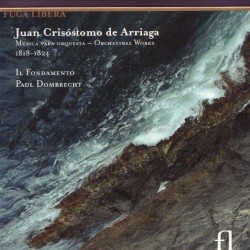 Música para orquesta2006
Tracklist not collected yet.
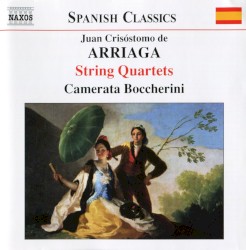 String Quartets2005
Tracklist not collected yet.
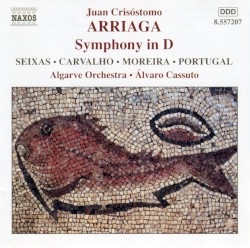 Symphony in D2003
Tracklist not collected yet.
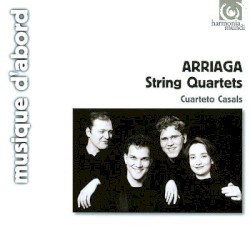 Cuartetos2003
Tracklist not collected yet.
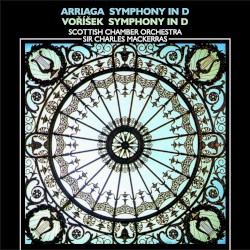 Arriaga: Symphony in D / Voříšek: Symphony in D1995
Tracklist not collected yet.
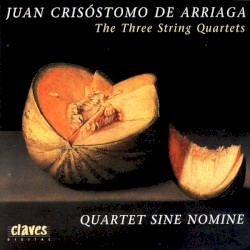 The Three String Quartets1995
Tracklist not collected yet.
 Turina: Sinfonía sevillana / Arriaga: Los esclavos felices / Halffter: Concierto para violín y orquesta1992
Tracklist not collected yet.
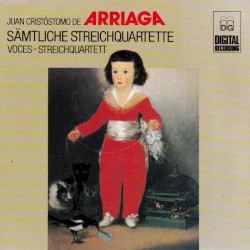 Complete String Quartets1988
Tracklist not collected yet.
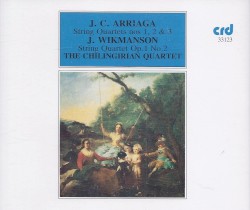 J. C. Arriaga: String Quartets nos. 1, 2 & 3 / J. Wikmanson: String Quartet op. 1 no. 2
Tracklist not collected yet.
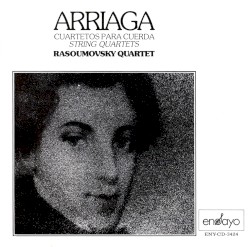 String Quartets
Tracklist not collected yet.
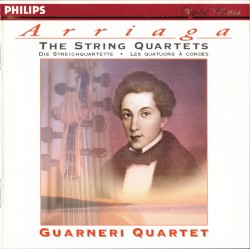 The String Quartets
Tracklist not collected yet.
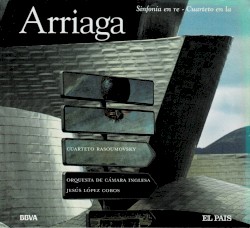 Sinfonia En Re, Cuarteto En La2004
Tracklist not collected yet.
Gallery


Similar artists



Archive
Passport
Identifiers & aliases
Also known as: Jean Arriaga, Juan Crisóstomo Jacobo Antonio de Arriaga y Balzola
Juan Crisóstomo Jacobo Antonio de Arriaga y Balzola was a Spanish Basque composer. He was nicknamed "the Spanish Mozart" after he died, because, like Wolfgang Amadeus Mozart, he was both a child prodigy and an accomplished composer who died young. They also shared the same first and second baptismal names; and they shared the same birthday, 27 January.
All links
Opinions of fans — not verified facts.
…