
Gay's early career included writing the play "The Mohocks," which faced censorship, showcasing the challenges he encountered as a playwright.
Despite censorship issues, Gay's sequel to "The Beggar's Opera," titled "Polly," became a financial success through public subscription, highlighting his enduring popularity.
John Gay was not only a poet but also a prominent playwright, contributing significantly to the genre of playwriting during the early 18th century.
Biography
Early Life
John Gay was born on June 30, 1685, in Barnstaple, England, as the youngest of five children in a family of respectable antiquity. His father, William Gay, passed away in 1695, and his mother, Katherine, died shortly thereafter. The Gay family was well-established in North Devon, with connections to local leadership and a comfortable lifestyle, though not wealthy. Gay received his education at the local grammar school before being apprenticed to a silk mercer in London. However, he soon returned to Barnstaple, where he was educated by his uncle, the Rev. John Hanmer, a nonconformist minister.
Career
Gay's literary career began with his first play, "The Mohocks," in 1712, which faced censorship challenges. He gained recognition with his comedy "The Wife of Bath" in 1713, and his friendship with Alexander Pope blossomed during this time. In 1714, he wrote "The Shepherd's Week," a series of pastorals that humorously critiqued contemporary pastoral works. Gay's most notable achievement came with the 1728 premiere of "The Beggar's Opera," a ballad opera that introduced iconic characters like Captain Macheath and Polly Peachum, making them household names. Despite facing challenges, including the censorship of his sequel "Polly," Gay's works continued to thrive, and he enjoyed the patronage of the Duchess of Queensberry until his death.
Legacy
John Gay passed away on December 4, 1732, in London and was buried in Westminster Abbey. His epitaph, penned by Pope, reflects his impact on English literature and theatre. Gay's innovative contributions to the genre of ballad opera and his sharp social commentary have left a lasting legacy in the world of drama and music, influencing future generations of playwrights and composers.
Collected from open sources (4) · facts link to sources · AI-processed
Discography
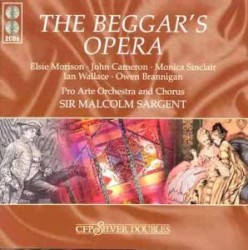 The Beggar's Opera1995
Tracklist not collected yet.
 The Beggar's Opera (The Broadside Band, conductor: Jeremy Barlow)1991
Tracklist not collected yet.
 The Beggar's Opera
Tracklist not collected yet.
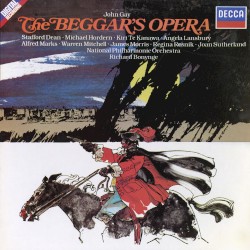 The Beggar's Opera
Tracklist not collected yet.
 The British Music Collection: The Beggar’s Opera
Tracklist not collected yet.
Gallery


Archive
Passport
Identifiers & aliases
John Gay was an English poet and dramatist and member of the Scriblerus Club. He is best remembered for The Beggar's Opera (1728), a ballad opera. The characters, including Captain Macheath and Polly Peachum, became household names.
All links
Opinions of fans — not verified facts.
…