
Stanisław Moniuszko is celebrated as a Polish composer who lived from 1819 to 1872.
He is known for his contributions to the opera genre, significantly shaping Polish national opera.
Moniuszko's music is infused with patriotic folk themes from the former Polish–Lithuanian Commonwealth.
Biography
Early Life
Stanisław Moniuszko was born on May 5, 1819, into a noble landowning family in Ubiel, located in the Minsk Governorate of the Russian Empire, which is now part of Belarus. His father, Czesław, and uncle, Ignacy, both served in Napoleon’s army, which likely influenced his early exposure to music and culture. Moniuszko's first piano teacher was his mother, Elżbieta Madżarska, who had Armenian roots. He pursued further musical education in Warsaw and Minsk, eventually studying under Carl Friedrich Rungenhagen in Berlin.
Career
Moniuszko's career as a composer, conductor, organist, and pedagogue flourished after he married Aleksandra Mueller in 1840, with whom he had ten children. Settling in Vilnius, he took on the role of organist at the Church of St. John's and began offering private music lessons, which became a vital source of income. His early operettas, such as "Loteria" and "Żółta szlafmyca," did not achieve significant success, but his 1847 opera "Halka" marked a turning point, receiving acclaim during its premiere in Vilnius, which he conducted himself. Moniuszko later traveled to Sankt Petersburg, where his music was well-received, and he mingled with prominent Russian composers like Mikhail Glinka and César Cui.
Legacy
Stanisław Moniuszko is often referred to as the "father of Polish national opera," and his works are characterized by the incorporation of patriotic folk themes from the former Polish–Lithuanian Commonwealth. His notable operas, including "The Haunted Manor" and "Halka," remain significant in the Polish cultural landscape. Since the 1990s, he has also been recognized as an important figure in Belarusian culture, reflecting his lasting impact on the region's musical heritage. Moniuszko passed away on June 4, 1872, leaving behind a rich legacy that continues to influence Polish music today.
Collected from open sources (4) · facts link to sources · AI-processed
Discography
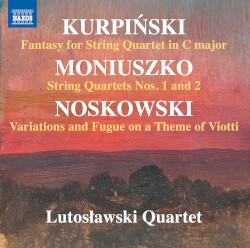 Kurpiński: Fantasy for String Quartet in C major / Moniuszko: String Quartets nos. 1 and 2 / Noskowski: Variations and Fugue on a Theme of Viotti2023
Tracklist not collected yet.
 Verbum nobile2022
Tracklist not collected yet.
 Hrabina2021
Tracklist not collected yet.
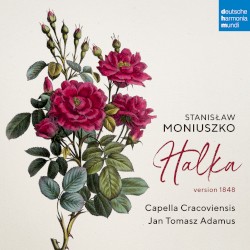 Halka2021
Tracklist not collected yet.
 Moniuszko: String Quartets 1 & 2 / Zarębski: Piano Quintet op. 342019
Tracklist not collected yet.
 Ballet Music: Hrabina / Halka / The Haunted Manor2017
Tracklist not collected yet.
 Overtures2014
Tracklist not collected yet.
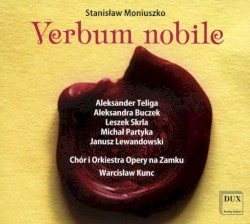 Verbum nobile2012
Tracklist not collected yet.
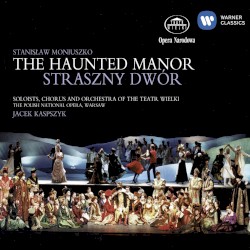 The Haunted Manor2004
Tracklist not collected yet.
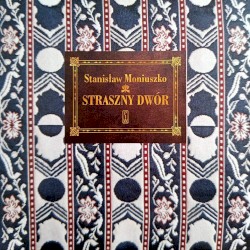 Straszny dwór (Montaż muzyczny)1992
Tracklist not collected yet.
 Halka1987
Tracklist not collected yet.
 Verbum nobile
Tracklist not collected yet.
Gallery


Similar artists


Archive
Passport
Identifiers & aliases
Also known as: Stanislaw Moniuszko
Stanisław Moniuszko was a Polish composer, conductor, organist and pedagogue. He wrote many popular art songs and operas, including The Haunted Manor and Halka, and his music is filled with patriotic folk themes of the peoples of the former Polish–Lithuanian Commonwealth. He is generally referred to as "the father of Polish national opera". Since the 1990s, Stanisław Moniuszko has been recognized in Belarus as an important figure to Belarusian culture as well.
All links
Opinions of fans — not verified facts.
…