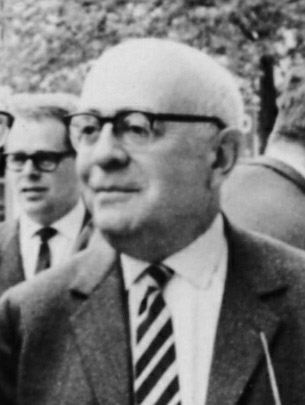
Theodor W. Adorno was a prominent German philosopher and music critic known for his critical theory and cultural critiques.
He received the Goethe Plaque of the City of Frankfurt for his significant contributions to philosophy and music.
Adorno's work primarily focused on classical music, where he made notable contributions as a critic and theorist.
Biography
Early Life
Theodor W. Adorno was born on September 11, 1903, in Frankfurt, Germany, as Theodor Ludwig Wiesengrund. He was the only child of Maria Calvelli-Adorno della Piana, a professional singer, and Oscar Alexander Wiesengrund, a successful wine exporter. His mother, a Catholic from Corsica, played a significant role in nurturing his musical talent, and by the age of twelve, he was already a child prodigy capable of playing Beethoven pieces on the piano. Adorno's early education included attending the Deutschherren Middle School and later the Kaiser-Wilhelm Gymnasium, where he graduated at the top of his class in 1921.
Career
Adorno's career as a philosopher, sociologist, and music critic flourished as he became a leading member of the Frankfurt School of critical theory. His intellectual influences included prominent figures such as Karl Marx, Hegel, and Freud, which shaped his critiques of modern society and the culture industry. Adorno's notable works include "Dialectic of Enlightenment" (1947), "Minima Moralia" (1951), and "Negative Dialectics" (1966), which have had a lasting impact on the European New Left. He was also recognized for his contributions to music, releasing albums such as "Kompositionen" and "Works for String Quartet."
Legacy
Adorno's legacy is marked by his critical approach to culture and society, as well as his philosophical inquiries into art and music. He was awarded the Goethe Plaque of the City of Frankfurt, acknowledging his significant contributions to the fields of philosophy and music criticism. Adorno passed away on August 6, 1969, leaving behind a profound influence on both philosophical thought and the understanding of music in the context of society.
Collected from open sources (4) · facts link to sources · AI-processed
Discography
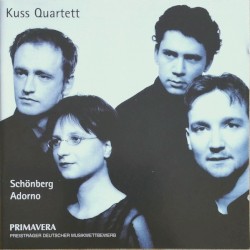 Schönberg / Adorno2003
- 1.Streichquartett Nr. 1 d-moll, op. 7: I. Nicht zu rasch12:47
- 2.Streichquartett Nr. 1 d-moll, op. 7: II. Scherzo. Trio12:14
- 3.Streichquartett Nr. 1 d-moll, op. 7: III. Adagio12:38
- 4.Streichquartett Nr. 1 d-moll, op. 7: IV. Finale. Rondo8:48
- 5.2 Stücke für Streichquartett, op. 2: I. Bewegt6:18
- 6.2 Stücke für Streichquartett, op. 2: II. Variationen5:34
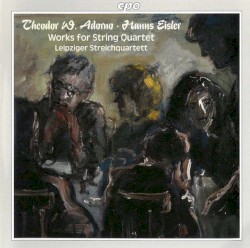 Works for String Quartet1996
- 1.String Quartet 1938, op. 75: I. Variationen5:48
- 2.String Quartet 1938, op. 75: II. Finale. Allegretto con spirito7:12
- 3.Präludium und Fuge über B-A-C-H für Streichtrio, op. 46: I. Präludium1:29
- 4.Präludium und Fuge über B-A-C-H für Streichtrio, op. 46: II. Fuge3:01
- 5.Six Studies for String Quartet: I. Sehr langsam, verträumt3:09
- 6.Six Studies for String Quartet: II. Nicht zu langsam, doch schleppend im Ausdruck1:25
- 7.Six Studies for String Quartet: III. Schwer und dumpf2:50
- 8.Six Studies for String Quartet: IV. Sehr heftig1:24
- 9.Six Studies for String Quartet: V. Langsam3:04
- 10.Six Studies for String Quartet: VI. Langsam2:18
- 11.String Quartet 1921: I. Mäßig2:13
- 12.String Quartet 1921: II. Sehr langsam4:07
- 13.String Quartet 1921: III. Äußerst rasch2:13
- 14.String Quartet 1921: IV. Ruhig6:48
- 15.Two Pieces for String Quartet, op. 2: I. Bewegt6:56
- 16.Two Pieces for String Quartet, op. 2: II. Variationen5:55
 Kompositionen1990
- 1.Zwei Stücke für Streichquartett, op. 2: I. Bewegt6:45
- 2.Zwei Stücke für Streichquartett, op. 2: II. Variationen5:01
- 3.Sechs kurze Orchesterstücke, op. 4: I. Bewegt, heftig1:30
- 4.Sechs kurze Orchesterstücke, op. 4: II. Sehr ruhig1:38
- 5.Sechs kurze Orchesterstücke, op. 4: III. Sehr lebhaft (Gigue)0:47
- 6.Sechs kurze Orchesterstücke, op. 4: IV. Äußerst langsam1:09
- 7.Sechs kurze Orchesterstücke, op. 4: V. Leicht (Walzer)0:41
- 8.Sechs kurze Orchesterstücke, op. 4: VI. Sehr langsam1:41
- 9.Drei Gedichte von Theodor Däubler für vierstimmigen Frauenchor a capella: 1. Dämmerung1:57
- 10.Drei Gedichte von Theodor Däubler für vierstimmigen Frauenchor a capella: 2. Winter1:54
- 11.Drei Gedichte von Theodor Däubler für vierstimmigen Frauenchor a capella: 3. Oft1:47
- 12.Zwei Lieder mit Orchester aus dem geplanten Singspiel "Der Schatz des Indianer-Joe" nach Mark Twain: 1. Totenlied auf den Kater1:39
- 13.Zwei Lieder mit Orchester aus dem geplanten Singspiel "Der Schatz des Indianer-Joe" nach Mark Twain: 2. Hucks Auftrittslied (Mit Kammerorchester)1:25
- 14."Kinderjahr". Sechs Stücke aus op. 68 von Robert Schumann, für kleines Orchester gesetzt: I. Frühlingsgesang1:54
- 15."Kinderjahr". Sechs Stücke aus op. 68 von Robert Schumann, für kleines Orchester gesetzt: II. Lied italienischer Marinari1:17
- 16."Kinderjahr". Sechs Stücke aus op. 68 von Robert Schumann, für kleines Orchester gesetzt: III. Mai, lieber Mai - bald bist Du wieder da!1:42
- 17."Kinderjahr". Sechs Stücke aus op. 68 von Robert Schumann, für kleines Orchester gesetzt: IV. Erinnerung (4. November 1847: Mendelssohns Todestag)1:51
- 18."Kinderjahr". Sechs Stücke aus op. 68 von Robert Schumann, für kleines Orchester gesetzt: V. Winterzeit (II)3:30
- 19."Kinderjahr". Sechs Stücke aus op. 68 von Robert Schumann, für kleines Orchester gesetzt: VI. Knecht Ruprecht2:00
Gallery


Achievements
- Award
- Goethe Plaque of the City of Frankfurt
Influenced by
Similar artists



Archive
Passport
Identifiers & aliases
Theodor W. Adorno was a German philosopher, cultural, and music critic. He was a leading member of the Frankfurt School of critical theory, whose work has come to be associated with thinkers such as Ernst Bloch, Walter Benjamin, Max Horkheimer, Erich Fromm, and Herbert Marcuse, for whom the works of Sigmund Freud, Karl Marx, and G. W. F. Hegel were essential to a critique of modern society. As a critic of both fascism and what he called the culture industry, his writings—such as Dialectic of Enlightenment (1947), Minima Moralia (1951), and Negative Dialectics (1966)—strongly influenced the European New Left.
All links
Metrics in detail
Opinions of fans — not verified facts.
…