
William Boyce was an English baroque composer known for his significant contributions to music in the 18th century.
Boyce was not only a composer but also an accomplished organist, active from 1711 to 1779.
Despite becoming deaf later in life, Boyce continued to compose music, showcasing his dedication to his art.
Biography
Early Life
William Boyce was born on September 11, 1711, in London, at Joiners' Hall, to John Boyce, a joiner and cabinet-maker, and Elizabeth Cordwell. He began his musical journey as a choirboy at St Paul's Cathedral in 1719, and after his voice broke in 1727, he studied music under Maurice Greene.
Career
Boyce's professional career took off in 1734 when he became the organist at the Oxford Chapel in London. He held several similar positions before being appointed Master of the King's Musick in 1757 and later became one of the organists at the Chapel Royal in 1758. His compositional work began in the 1730s, with notable pieces including the oratorio "David's Lamentation over Saul and Jonathan" and the opera "Peleus and Thetis." He was also a conductor at the Three Choirs Festival, where many of his works premiered.
Legacy
Despite being largely forgotten after his death in 1779, Boyce's music saw a revival in the 1930s, thanks in part to Constant Lambert, who published modern editions of his works. His church music, particularly, was preserved and published posthumously. Notably, Boyce's Symphony No. 1 was played during the wedding of Prince Harry and Meghan Markle in 2018, and his coronation anthem "The King Shall Rejoice" was performed at the coronation of Charles III in 2023. Boyce's contributions to music continue to be recognized, with his portraits created by renowned artists like Joshua Reynolds and Thomas Hudson.
Collected from open sources (4) · facts link to sources · AI-processed
Discography
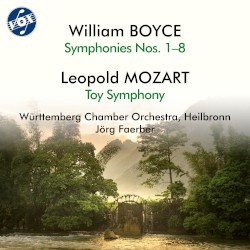 William Boyce: Symphonies nos. 1–8 / Leopold Mozart: Toy Symphony2025
Tracklist not collected yet.
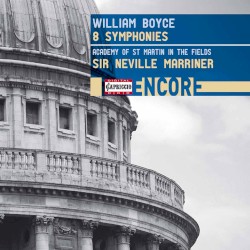 8 Symphonies2017
Tracklist not collected yet.
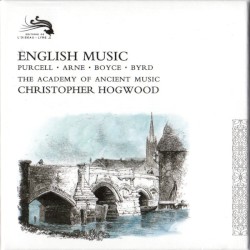 English Music2015
Tracklist not collected yet.
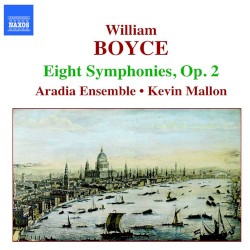 Eight Symphonies, op. 22005
Tracklist not collected yet.
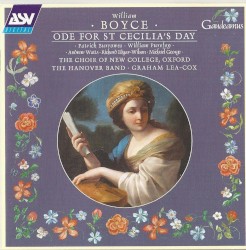 Ode for St Cecilia's Day2000
Tracklist not collected yet.
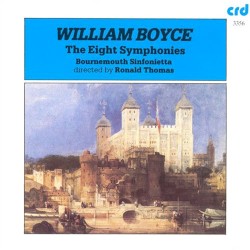 The Eight Symphonies1999
Tracklist not collected yet.
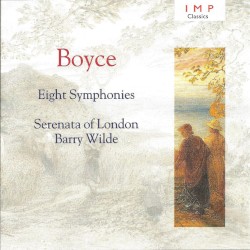 Eight Symphonies1997
Tracklist not collected yet.
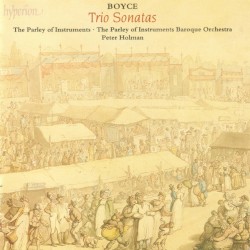 Boyce: Trio Sonatas1996
Tracklist not collected yet.
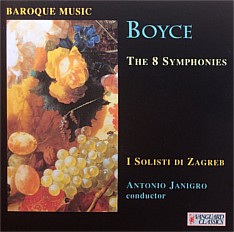 The 8 Symphonies1994
Tracklist not collected yet.
 The Eight Symphonies1994
Tracklist not collected yet.
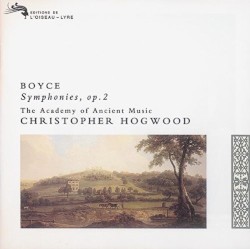 Symphonies, op. 21993
Tracklist not collected yet.
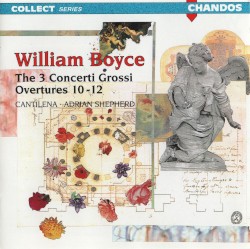 The 3 Concerti Grossi / Overtures 10-121992
Tracklist not collected yet.
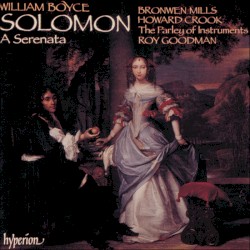 Solomon1990
Tracklist not collected yet.
 Boyce: The Eight Symphonies1988
Tracklist not collected yet.
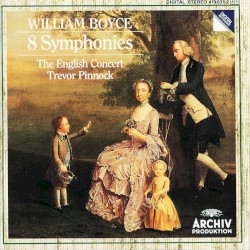 8 Symphonies1987
Tracklist not collected yet.
 Peleus and Thetis and other theatre music1987
Tracklist not collected yet.
Gallery


Similar artists


Archive
Passport
Identifiers & aliases
William Boyce was an English composer and organist. Like Beethoven later on, he became deaf but continued to compose. He knew Handel, Arne, Gluck, J. C. Bach, Abel, and a very young Mozart, all of whom respected his work.
Opinions of fans — not verified facts.
…